Confused about RWC meaning and whether you actually need one before selling your car? You are not alone. Understanding what a roadworthy certificate is, when it is legally required, and how much it costs can save Melbourne sellers significant time, money, and stress. Furthermore, knowing your options, including the option to sell without one, puts you firmly in control before your next transaction.
Roadworthy Certificate Meaning: What Is an RWC?
The meaning of RWC is straightforward: a roadworthy certificate is an official document certifying that a vehicle meets the minimum safety standards enforced by VicRoads across Victoria. Importantly, it is not a full mechanical inspection. According to Transport Victoria, a roadworthy certificate shows your car is currently safe to drive, but does not guarantee it is mechanically reliable. For the full official definition, visit the Transport Victoria Roadworthy Certificate page.
A roadworthy inspection is not a pre-purchase inspection and does not assess the vehicle’s overall condition or mechanical reliability. It simply confirms the car is safe to drive on Victorian roads at the time of testing.
RWC Meaning in Victoria: When Is a Certificate Required?
In Victoria, understanding the meaning becomes especially important when a seller transfers a vehicle to a new owner. The vehicle owner must provide the buyer with a current roadworthy certificate, unless the buyer is a spouse or a motor vehicle trader.
Sellers can legally sell a vehicle without a roadworthy certificate if the vehicle carries no current registration. However, before that vehicle can be re-registered, the buyer must obtain an RWC.
An RWC is required in Victoria when:
- ✅ Selling a registered vehicle to a private buyer
- ✅ Re-registering a vehicle with expired registration
- ✅ Transferring ownership in most standard transactions
- ✅ Clearing a defect notice that Victoria Police issued
What Gets Checked in a Roadworthy Inspection?
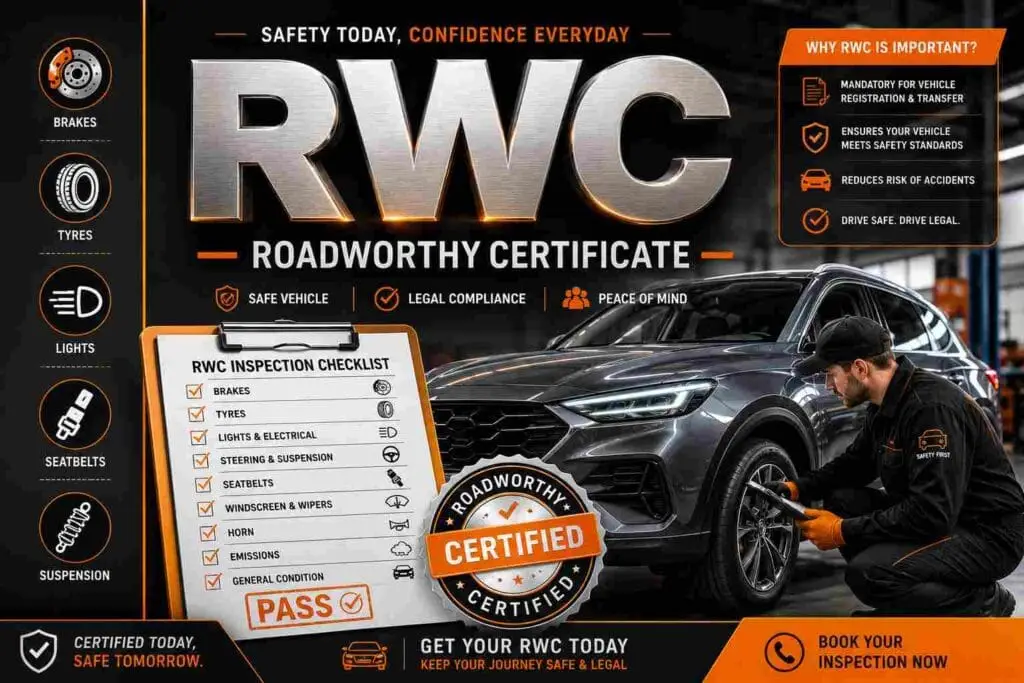
Licensed vehicle testers conduct the RWC inspection, meaning a roadworthy certificate, to ensure vehicles meet the safety standards essential for operating on public roads. Licensed vehicle testers inspect approximately 40 safety-related items.
Key items inspected during a roadworthy:
- Brakes, brake fluid, and warning systems
- Steering, suspension, and wheel alignment
- Tyres: tread depth, condition, and fitment
- Seats and seatbelts: mounting and operation
- Lights, indicators, and reflectors
- Windscreen, windows, and wipers
- Structural integrity of the body and chassis
The certificate is valid for 30 days from the date of issue and confirms that at the time of inspection, the vehicle complied with the prescribed standards.
Roadworthy Certificate Cost: What Should You Expect to Pay?
There is no fixed VicRoads fee for a roadworthy certificate in Victoria. Licensed vehicle testers set their own prices, meaning inspection costs can vary considerably between workshops in Melbourne. Comparing quotes can help you save money when preparing to sell your car.
The average cost of a roadworthy certificate in Victoria typically ranges between $160 and $220 for standard vehicles. Larger vehicles, including SUVs, 4WDs, and vans, may attract higher fees due to additional inspection time.
Factors that affect your RWC cost:
- Vehicle type and size
- Age and overall condition of the car
- Whether repairs are needed before passing
- Re-inspection fees if the vehicle initially fails
- Location: Some outer suburban testers charge slightly more
A workshop charging $80–$120 is typically running a high-volume operation; they inspect quickly, and in some cases, this means less thoroughness. Always choose a VicRoads-licensed tester with verified reviews.
Get RWC Certificate: Or Skip It Entirely?
Here is something many Melbourne sellers do not realise: Victorian law does not require sellers to obtain an RWC before selling an unregistered car. This is exactly where selling your car without a roadworthy becomes a practical and completely legal option.
Additionally, how long a roadworthy lasts matters if you obtain one early, because the 30-day window means timing your inspection correctly is essential. Otherwise, it expires before the sale is finalised, and you pay twice.
For sellers with damaged, old, or unregistered vehicles, there is a simpler alternative. Melbcarremoval buys cars in any condition, with or without a current RWC.